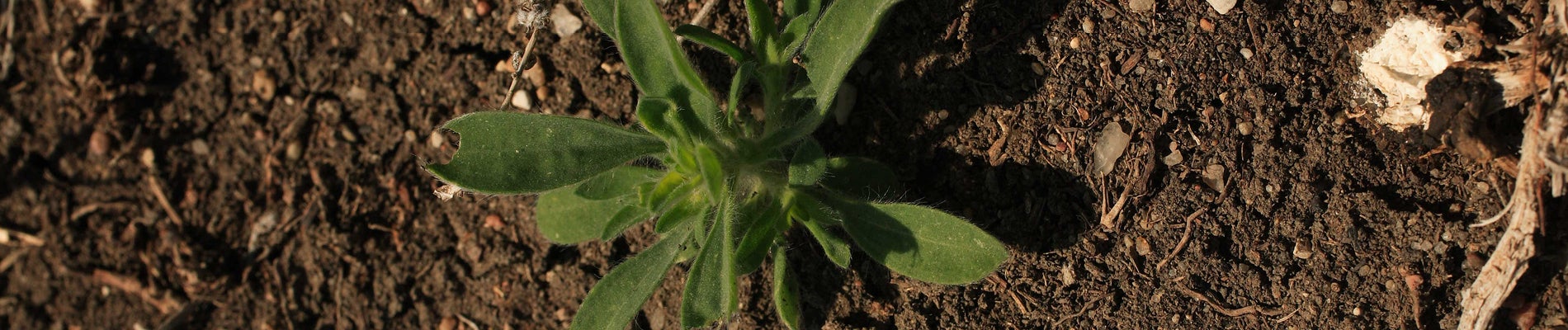
Everyone knows kochia is one of the most challenging weeds on the Prairies. It emerges early in cool spring soils, often before crops are even planted. It produces large amounts of seed that disperse widely and thrives in dry, hot and saline conditions where crops struggle.
Herbicide resistance adds another layer of difficulty. Kochia populations across Western Canada have developed resistance to multiple herbicide groups, making single-pass or single-mode-of-action approaches less reliable.
Managing this weed increasingly requires a more complete strategy, one that combines strong burnoff of emerged plants with extended residual control to manage later germinating kochia.
Fortunately, growers still have several effective tools available. Combining chemical and cultural practices can help reduce kochia pressure and slow resistance development. PrecisionPac® herbicide blends offer one approach, providing customized combinations of herbicides dispensed in convenient premeasured bags. Each blend delivers the exact amount needed down to the acre, helping reduce waste while simplifying handling and storage.
PrecisionPac® Complete Solution Herbicides
PrecisionPac® PF-100-0050 herbicide
A complete solution blend with extended control of grassy and broadleaf weeds
Take control of your toughest-to-control weeds with PrecisionPac® PF-100-0050 herbicide ahead of spring (excluding durum) and winter wheat. This complete solution herbicide blend provides control of emerged weeds like cleavers, narrow-leaved hawk’s-beard, lamb’s-quarters and wild buckwheat, plus extended control of key grassy and broadleaf weeds like green and yellow foxtail, Japanese brome, cleavers, downy brome and suppression of Group 1 and 2 herbicide-resistant wild oats. The Group 2 and 15 modes of action provide effective weed control while helping delay the onset of herbicide resistance.
PrecisionPac® SZ-0050 herbicide
Consistent broadleaf burnoff with extended kochia control
When tank-mixed with glyphosate, three active ingredients give PrecisionPac® SZ-0050 herbicide consistent control, stopping growth down to the root across a wide range of broadleaf weeds with no regrowth — plus extended control of Group 2- and 9-resistant kochia and suppression of Russian thistle for preplant use on spring and durum wheat, field peas and soybeans.
Research builds kochia knowledge and tools
Having studied kochia for years, Dr. Charles Geddes would be the last person to minimize the headaches associated with this weed. Even so, the Lethbridge-based Weed Scientist with Agriculture and Agri-Food Canada is inclined to see kochia as a glass-half-full situation. Despite the challenges, there’s still lots that growers can do. His research points the way.
Dr. Geddes and his team looked at managing kochia through the span of a four-year crop rotation – wheat, canola, wheat, lentils – integrated with cultural and chemical practices, in order to develop management strategies taking advantage of the biology and ecology of kochia.
The research team mapped out how to use available herbicide modes of action in combinations that help reduce resistance pressure. This approach — often called herbicide layering — involves using effective modes of action for the same weed species at multiple points in the season, including pre-emergent, post-emergent, in-crop, pre-harvest or post-harvest applications. By exposing kochia to multiple modes of action and maintaining control over a longer period, growers can reduce escapes and help slow the development of resistance.
A well-chosen crop rotation helps keep kochia on the defensive, and fall-planted crops shouldn’t be overlooked.
Dr. Geddes has also looked at crop rotation diversity. In one experiment of a spring wheat, canola, spring wheat, lentils rotation they swapped out spring wheat with winter wheat.
"We’re trying to promote a competitive crop rotation,” says Geddes, “because kochia tends to respond to crop competition. It responds by reducing the amount of seed the plant produces. Winter wheat can be competitive in the spring with kochia that’s just trying to emerge. Winter wheat is also harvested before kochia produces viable seed."
Two means of increasing crop competitiveness were found to be effective in combatting kochia: narrower row spacing and increasing seeding rate. This is evidence that kochia backs down when the going gets tough.
"Decreasing row spacing showed a 60% decrease in kochia biomass in all crops,” says Geddes. “Adding in this cultural management is essentially like adding another herbicide to the tank."
Seeding rates combined with herbicide management can help reduce the potential for resistance in kochia.
However, if only one farmer in a region is diligent about these kochia management practices, the benefits may be limited. Kochia is a prolific seed producer and spreader, and new seed can easily blow in from neighbouring fields.
That’s why Charles Geddes believes coordinated efforts among growers could make a meaningful difference. When farmers in a region work together to reduce kochia seed production over several seasons, the overall seedbank can begin to decline — making the weed easier to manage across the landscape.
"There’s a lot of opportunity for community-based strategies,” says Geddes. “For example, farmers within a certain area could commit to managing kochia effectively for several years in a row. Combined with chemical and cultural practices, this could make a big difference over time."
Want to learn more about kochia? Check out this webinar presented by Charles Geddes, along with this special 16-page kochia supplement developed for you by FMC.