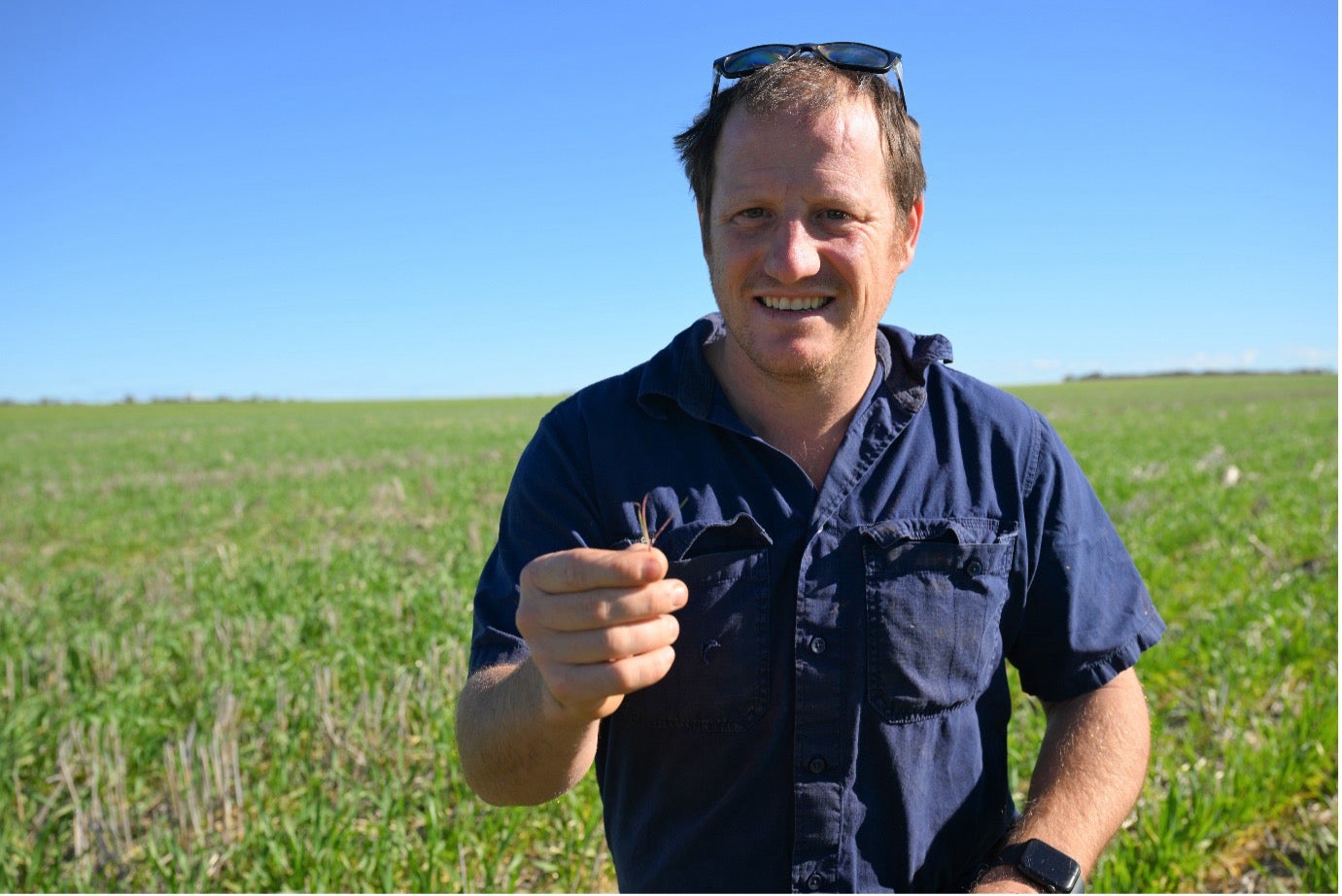
On a property that has been in the family for more than 100 years, William Roach is optimistic that their farming practices are keeping weeds at bay.
The property is in Dalwallinu, in the wheat belt of Western Australia, where they grow a variety of crops including wheat, barley and canola.
Mr Roach said the farm is characterised by a mixture of soil types, including sandy, clay, and duplex soils.
This diversity presents challenges when it comes to tasks like seeding, germination, and weed control. Different soil types require tailored approaches, as varying conditions affect seedbed preparation and chemical effectiveness.
Ryegrass is the most significant challenge in terms of weed control although other weeds such as Wild radish, brome grass, spear grass and barley grass are of some concern.
“You're trying to beat the grasses every year,” Mr Roach said. “Every year is different. With the rotation of chemistry, you can stay on top of it, but it's not just a one-year solution.”
He said they were often planning their weed control years ahead and would even put in a fallow, as a break option.
“You obviously have to rotate through different chemicals and there’s a lot of new chemistry coming onto the market, which can assist.”
“We rely heavily on pre-emergent chemistry and use it on all our cereals. It is obviously the key around here and the longer it lasts, the better it works.”
Products such as Treflan* have been used historically on the property but have been replaced by some of the newer options.
“There is a lot of dry seeding happening now and Treflan* doesn’t quite work as well and I also feel there is resistance coming in,” Mr Roach said.
One of the newer herbicides being utilised in recent years is Overwatch® Herbicide, from FMC, which has performed particularly well.
“The first year I used Overwatch® was 2023,” he said. “That year we didn’t get a huge amount of rainfall, but I did see how well it worked and the weed control we achieved.
It was also used in 2024, with wet conditions at planting challenging herbicide and seeding application, but Overwatch® continued to perform well.
“We’ve used it a lot more this year,” Mr Roach said. “In the previous years where we did use it, the weed control was a lot better, and I would say the yield was also marginally better.”
Overwatch® can whiten the crop when conditions are not ideal, and this is something that occurred on the property in 2024.
“It can bleach the crop, and you do get a little bit nervous there for a week or two, but it does grow through it,” Mr Roach said. “Once you realize that it will grow through, you're pretty comfortable using it.”
“I need a chemical that can last well into the season. I do think it is a safe product if you don't get big furrow fill, but even seeing that, it’s growing through, and the end result is very good.”
“I would like to have the seeding depth uniform throughout the paddock, however, with mixed soil types that can be a struggle at times. It is a goal to have it 30mm below the surface and ideally, soft opening rain which can help with germination and not have chemical fall into the furrows.”
This season Overwatch® Herbicide has been used extensively in barley and in a tank mix with Sakura* herbicide in wheat.
“No Treflan* went out this year,” Mr Roach said. “It was the first year, in a lot of years, where there had been no Treflan*. Overwatch® with Sakura* worked quite well.”
Overwatch®’s mode of action, which turns the ryegrass a magenta colour, was noticeable for long periods of the season.
“You can see a lot of magenta ryegrass come through and then it will die away,” Mr Roach said. “It's quite amazing to see a lot of magenta and then see it turn. It’s brilliant chemistry.”
He said Overwatch® Herbicide has been used in wheat and barley on the property and there have been reports locally of the herbicide working well on canola.
Canola is the first crop sown on the property, followed by barley and wheat, with the first and second week of April the preferred target for planting.