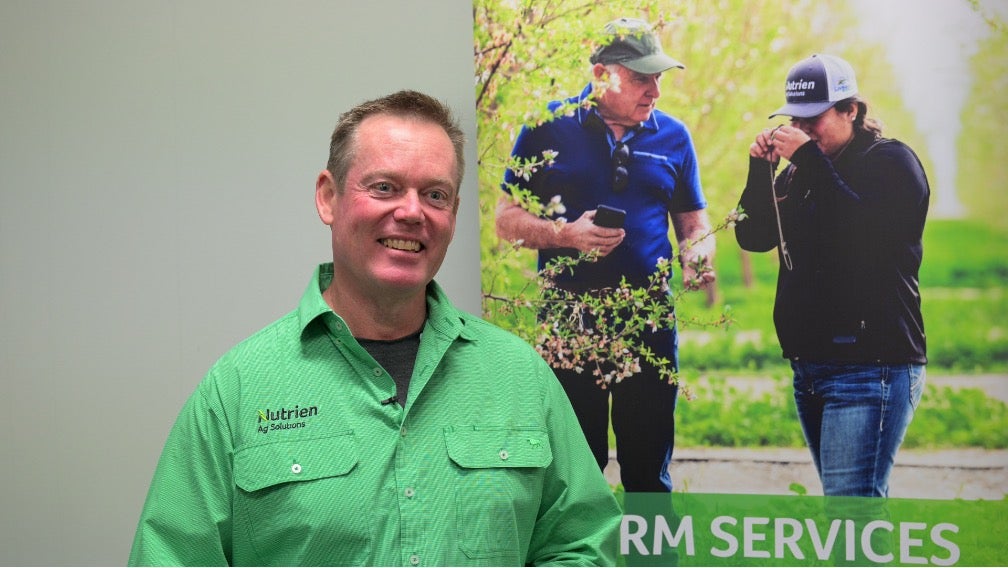
Trials conducted by Nutrien Product Development Agronomist, Richard Stone, have demonstrated the excellent performance of Overwatch® Herbicide across many seasons and soil types.
Mr Stone conducts small plot trial work, each year, in multiple locations across Western Australia’s northern cropping region.
“It is vital for our network of agronomists,” he said. “We get to look at chemicals under development with our leading suppliers often two to three years ahead of when they are launched. “We get a concept of how we can fit them into our systems here in Western Australia.”
Nutrien was provided with Overwatch® Herbicide to sample well before it became available commercially and was compared to products such as Trifluralin and Sakura* on its own and in tank mixtures.
“Our go-to standard was trifluralin on its own which was delivering around 70 per cent long-term control of ryegrass. Sakura* on its own was in the low to mid 80 per cent control of ryegrass. Overwatch® Herbicide on its own showed it was performing in that range with Sakura* so that was good to see.”
He said they found the key to excellent weed control was to tank-mix products which would increase the control of annual ryegrass to 90 per cent or above.
“I'd always want to see at least two different modes of action up front, and then, if you can come back with a third that is fantastic.”
“Something like Overwatch® and Trifluralin up front is super valuable, and I find coming back early post emergent with a pyroxasulfone based product such as Mateno* Complete to be excellent. That's a really strong strategy for season long weed control.”
He said over six or seven years of trial work, the Overwatch® / Treflan combination was averaging 90 to 91 per cent control and the addition of an early post emergent option helped farmers that were needing to control very high ryegrass numbers.
“Overwatch® provides excellent residual activity on ryegrass,” he said. In his experience, the residual action of pyroxasulfone is slightly shorter, so if you apply a pyroxasulfone based product as Mateno* Complete early post-emergent, the residual effect of both chemistries, one applied IBS the other EPE, will see then working alongside each other until they run out of steam almost at the same time.”
“They are both providing long lasting control and protecting each other through their different herbicide modes of action, ideal for more effective resistance management. You are not leaving one out to dry at the end, so I see that sort of thing as really valuable.”
Mr Stone said he had also conducted three years of trials with Overwatch® and Sakura* up-front, which demonstrated superior weed control and very little crop effect.
Overwatch® Herbicide is registered for the suppression of Wild radish and this combination, particularly in conjunction with a dedicated broadleaf spray, was a very handy option.
Many Western Australian farmers are cropping large hectares of land so chemistry that can help control a range of weed types for a longer period was worthwhile.
He said annual ryegrass is the number one enemy, and farmers are also challenged by a smorgasbord of weeds including wild oats, brome grass, barley grass, wild radish and capeweed – all of which are on the Overwatch® Herbicide label.
Growers often had high ryegrass numbers when converting old livestock blocks to cropping so an Overwatch® -based program could provide maximum control of ryegrass and other weeds.
“They need to get on top of those weeds and stay on top of them,” Mr Stone said.
Overwatch® Herbicide has the advantage of being registered for wheat, barley canola and select pulses, so is a flexible option in conjunction with post-emergent options including TruFlex* and Clearfield.
He said West Australian farmers have really grabbed the bull by the horns in terms of controlling ryegrass and look at it as a multi-year rotation in terms of crop types and chemistry.
“Let’s rotate through these and give the weeds less of a look every year at the one mode of action.”
The years of trialing have provided Mr Stone with an opportunity to evaluate Overwatch® and other chemistry for weed control, yields and also crop effect.
“I haven't seen it at all, in any of my trials with Overwatch®, where crop phytotoxicity has impacted yield,” Mr Stone said.
“Regardless of whether Overwatch® was on its own, or in a combination with Treflan* or something else, and regardless to what it did to the crop early, it was always either top or equal top for yield.
“I think Overwatch® Herbicide gives the crop enough time to recover and it is also visual with the way it works”
He said most of the other herbicides were not super visual and so damage being done may not be immediately apparent.
“That's the beauty of small plot trials in a particular soil type and conditions, because we can actually see significant differences if they are there.”
Mr Stone said farmers should look at incorporating Overwatch® Herbicide into their program sooner rather than later to protect against resistance and prolong the life of other herbicides.